Korea's AI Windfall: Avoiding the K-Shaped Economy
Seoul, July 2026
Chipmakers and asset owners could soar while wage earners are left behind. Economists, technologists, and policymakers gathered in Seoul at a workshop co-organized with the Bank of Korea to test whether Korea's next transformation can hold its social contract together.
Our Scenarios Program convenes economists, AI researchers, policymakers and civil society leaders to explore the implications of transformative AI, and to identify the policy responses each future demands. The workshops are complemented by the Policy Atlas—a continuously updated guide to policy options.
We believe that countries should develop Economic Preparedness Plans. Our workshops and the Atlas are designed to provide the foundation for doing so.
Korea gave the world K-pop, K-dramas and K-beauty. At a recent Seoul workshop, the “K” on everyone's mind was a different one: the K-shaped economy, where a technology boom splits a society in two. On the upward arm are chipmakers, model owners, platforms, and anyone who holds assets such as equity in Samsung or SK Hynix. On the downward arm are wage earners, young graduates, and anyone whose living depends on selling labor rather than owning capital. GDP goes up. Most people's prospects don't.
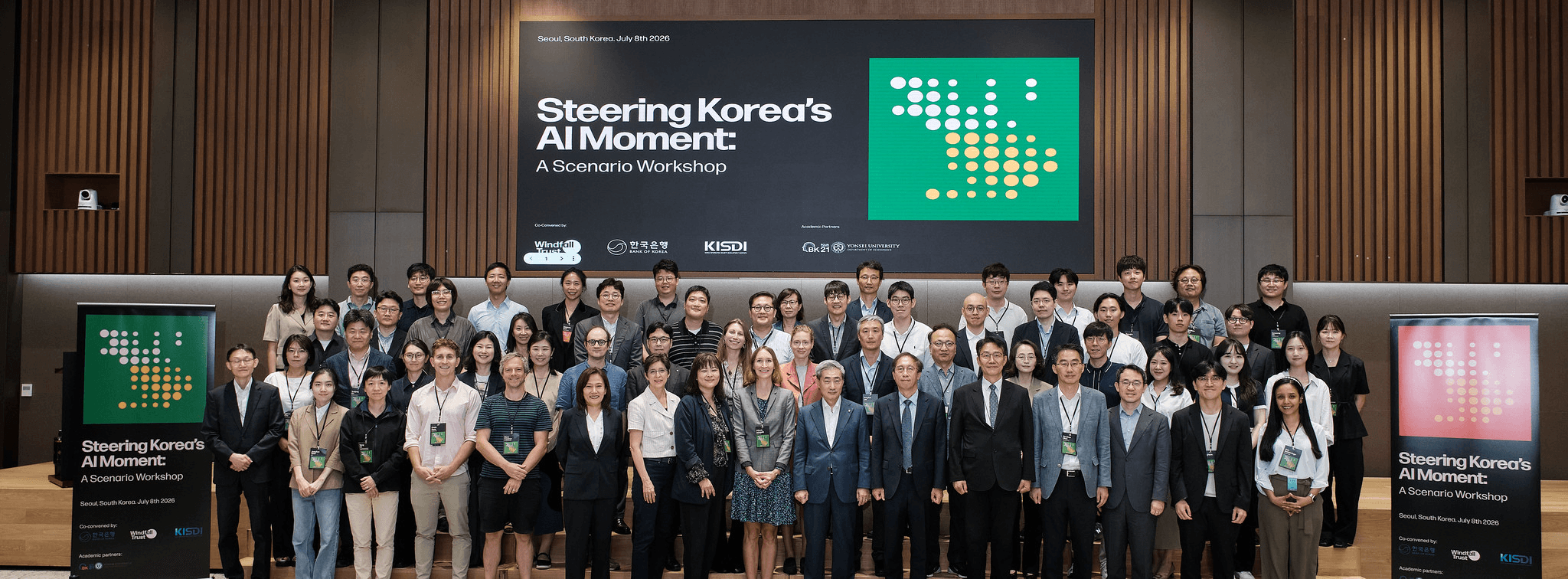
In July, a group of economists, technologists and policymakers gathered in Seoul to spend a day inside two versions of Korea in 2032. Both futures assumed AI would get very capable, very fast. What differed was who captured the gains—and whether Korea's response held its social contract together.
Why Korea's AI question isn't the West's AI question
Two structural conditions set Seoul's conversation apart from Washington's or Brussels'.
Chips. In the AI buildout, Korea supplies the picks and shovels. Every AI model is trained and run on specialized processors, and those processors are useless without high-bandwidth memory chips—a market Samsung and SK Hynix dominate. When AI wealth shows up in the West, it lands across a relatively diffuse tech sector. When it shows up in Korea, it concentrates in a handful of semiconductor firms. Korea's chip-driven tax revenue is running so far ahead of forecast that some in the government have proposed a "future response fund" to invest the surplus in housing, jobs, and young people.
Demographics. Korea has the world's lowest fertility rate. In a country running out of workers, AI that could double what a nurse or a teacher can do reads less as a threat than as relief. Nevertheless, white collar job displacement can accelerate a looming pension crisis.
Together, these conditions put Korea in many ways at the forefront of thinking about the AI transition.

Opening remarks by Hyun Song Shin, Governor of the Bank of Korea
A country that knows how to reinvent itself
The case for optimism was voiced repeatedly in the room: Korea has pulled off improbable transformations before, moving from postwar industrialization to shipbuilder, chipmaker, and global cultural superpower within two generations. That history matters, because the workshop's deepest concerns were about people and talent.
The entry-level pipeline breaks first. In both futures explored at the workshop, firms stop hiring and training juniors, automating the work young graduates were promised. Korea has the highest rate of tertiary education in the world. For a society built on the bargain that intense education buys a stable, white collar career and upward mobility, that is a promise of major social upheaval.

Opportunity and precariousness, in one position
Are Korea's picks and shovels a source of steady riches, or a chokepoint that others are already working to route around—through rival memory-makers, export controls, and the brutal cyclicality of chip prices? Both descriptions are true, and that duality is what makes Korea's moment simultaneously an enormous opportunity and a precarious one.
The tension in the room kept circling: every plan for sharing the windfall depends on the windfall continuing. Redistribute too little and the K-shape hardens; redistribute without reinvesting, and Korea risks losing the chip advantage that funds everything. Skeptics in the room pushed further still: when vast wealth depends on a handful of firms with the leverage to threaten exit, profit-sharing agreements can dissolve, so the state may need binding guardrails before the allocation debate begins. One closing intervention went further, questioning whether the windfall is truly within the public's reach at all.
One group crystallized the underlying design problem: societies need a cushion and a spur: a cushion for the people the transition displaces, without dulling the spur that keeps an economy inventive and competitive. One question went unanswered: is it worth investing in competing to develop a near-frontier AI model, or cede sovereignty to foreign model developers?

Why the rest of us should watch Seoul
Every developed economy will eventually face some version of this: AI wealth concentrating, populations aging, education systems tuned for a previous era. Korea is simply getting there first—early enough to choose, and holding real cards while it chooses.
The lessons from Korea can inform the design of technology, education, labor, and social policy that is robust in the 21st century. One of the more striking moments came in the closing round, when participants who had run this same exercise in other countries observed that doing it from Korea's position of strength produced something closer to optimism than dread. The window to prepare is open. The debate is happening in public, in real time.
Korea turned an industrial base into a cultural superpower once already. Whether it can turn a chip windfall into broadly shared prosperity is worth watching—not because other economies can copy the plot, but because the choices it turns on are ones many advanced economies may eventually face.
If you are working on these questions and want to be part of the conversation, contact us at contact@windfalltrust.org, or follow our newsletter, the AGI Social Contract, at windfalltrust.substack.com.